
The 30 bathroom vanity: Solving Atlanta’s Small Bathroom Squeeze
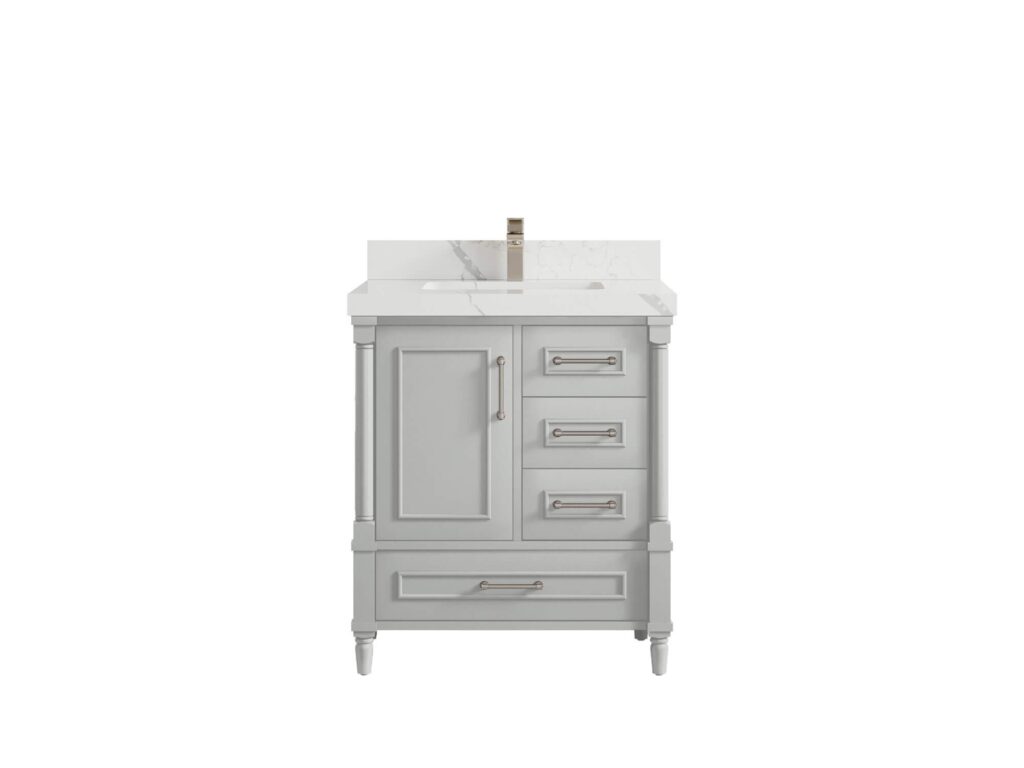
Walk into a bungalow 30 bathroom vanity in Inman Park, and you’ll see the problem immediately. Five feet of width, if you’re lucky. These houses went up in the 1920s, long before anyone planned around double sinks or wide cabinet runs. The plumbing stacks sit where they sit.
Narrow doorways make it worse. A delivery crew hauling a 36-inch cabinet through an original 1920s doorframe is fighting math they can’t win.
A 30-inch bathroom vanity solves that fight before it starts. It’s not a downgrade from something bigger. It’s the piece built for the room you actually have.
Why homeowners get this wrong:
- They shop for the biggest cabinet the budget allows, not the one the floor plan allows.
- They skip measuring the actual doorway and hallway path the piece has to travel.
- They assume “standard” bathroom size applies to a house built a century ago.
Table of Contents
- The Layout Math of a 30-Inch Profile
- Solving the Internal Plumbing Puzzle
- Pre-Purchase Checklist for Local Homeowners
- Frequently Asked Questions
The Layout Math of a 30-Inch Profile
Cabinet width isn’t a style choice here. It’s a clearance problem with a right answer.
How the three common sizes actually behave in a small bath:
- A 24-inch cabinet feels stingy fast. Drawers clip the towel bar every time you open them.
- A 36-inch unit crowds the toilet or shower door, sometimes both at once.
- A 30-inch bathroom vanity splits the difference and keeps roughly 21 to 24 inches of open floor in a typical 60-inch-wide bath.

Toilets need about 15 inches of centerline clearance. Shower doors need their full swing arc, not just the closed footprint.
A standard basin on a 30-inch top leaves 5 to 6 inches of usable counter on either side. Room for a soap dish, not a warehouse.
Contractors who install these daily check the door swing arc first, before the floor area. A cramped arc turns a morning routine into an obstacle course.
Get this math wrong once, and you’ll bump your elbow on that wall every single day. Get it right, and you forget the cabinet is even tight.
That’s the whole case for a single sink vanity in Atlanta bathrooms this size: the numbers work, so nothing about daily use feels cramped.
Solving the Internal Plumbing Puzzle
Here’s what most buyers never think to check: what’s happening behind the cabinet door.
Cheap units build a flat shelf straight across the back, right where the P-trap and supply risers sit. Something has to give, and it’s usually your storage.
What a well-built 30-inch bathroom vanity does differently:
- U-shaped drawer boxes wrap around the plumbing instead of ignoring it.
- The bottom drawer stays fully usable, glides and all.
- Nothing gets hand-cut or hacked into the factory wood to make room.
Atlanta code typically puts the drain stub 18 to 20 inches above the subfloor. A flat shelf simply can’t clear that.
Why solid hardwood beats MDF in this climate:
- Georgia humidity swings hard between seasons, even with a working exhaust fan.
- Kiln-dried hardwood expands and contracts predictably through those swings.
- Particleboard absorbs moisture unevenly and warps first along the seams.
- Mortise-and-tenon joinery moves with the wood. Stapled composite frames just crack.
Give it a year or two and cheap MDF starts swelling at the joints. Properly sealed hardwood doesn’t budge.
Upgrading the Stone and Hardware
Here’s the upside of going smaller: the countertop budget gets bigger.
Choosing a 30-inch bathroom vanity instead of a wider run frees up real money for the surface on top, not extra cabinet square footage nobody uses.
Stone worth spending on:
- Calacatta quartz for a bright, consistent veining pattern with zero maintenance.
- Honed natural marble for a softer, matte finish that ages beautifully.
- A single 30-inch slab shows off the best veining instead of getting awkwardly cut from a wider piece.
That’s exactly the calculation behind a well-planned single sink vanity in Atlanta homes, where every square foot of floor space carries a premium.
Hardware pairings that read as intentional:
- Brushed brass pulls against a fluted wood front.
- Matte black hardware against a flat painted shaker door.
- Each drawer has two smaller pulls rather than one large center handle that could overpower a narrow front.
Pre-Purchase Checklist for Local Homeowners
Before you order anything, confirm these on-site yourself. Skipping this step is how installation day turns into a delay.
- Measure the exact vertical distance from the subfloor to the center of the wall drain pipe.
- Check door and drawer swing clearance against the toilet tank, shower door frame, and any adjacent wall.
- Assume the wall isn’t plumb. Older Atlanta homes almost never are, so pick a cabinet with adjustable leveling feet built into the base.
- Confirm the supply valve height lines up with the cabinet’s back panel cutout before delivery day.
A floor plan won’t catch century-old plaster walls that lean an inch off true. A contractor checking in person will.
Visit the showroom with a tape measure of your own. Comparing real numbers against a display unit catches mismatches before they become expensive.
Vanity Store Atlanta keeps working display units on the floor for exactly this reason. You can open every drawer and check the joinery yourself, no obligation attached.
That kind of hands-on comparison matters most when shopping for bathroom furniture in Atlanta‘s older, uneven housing stock, where no two bathrooms measure quite the same.
Frequently Asked Questions
Is a 30-inch vanity big enough for a single sink?
Yes. A single sink vanity in Atlanta this size comfortably fits a 16 to 18-inch basin with room left over on both sides. Most single-occupant bathrooms never need more width than that.
What is the ideal mirror size to place above a 30-inch vanity?
Go with 24 to 28 inches wide. That leaves roughly an inch of reveal on each side of the 30-inch bathroom vanity below, reading as intentional rather than an afterthought.
Where can I find high-quality bathroom furniture in Atlanta that isn’t made of MDF?
Look for solid hardwood construction and dovetail joinery. A real showroom selling bathroom furniture in Atlanta will open the cabinet for you on request, no hesitation.